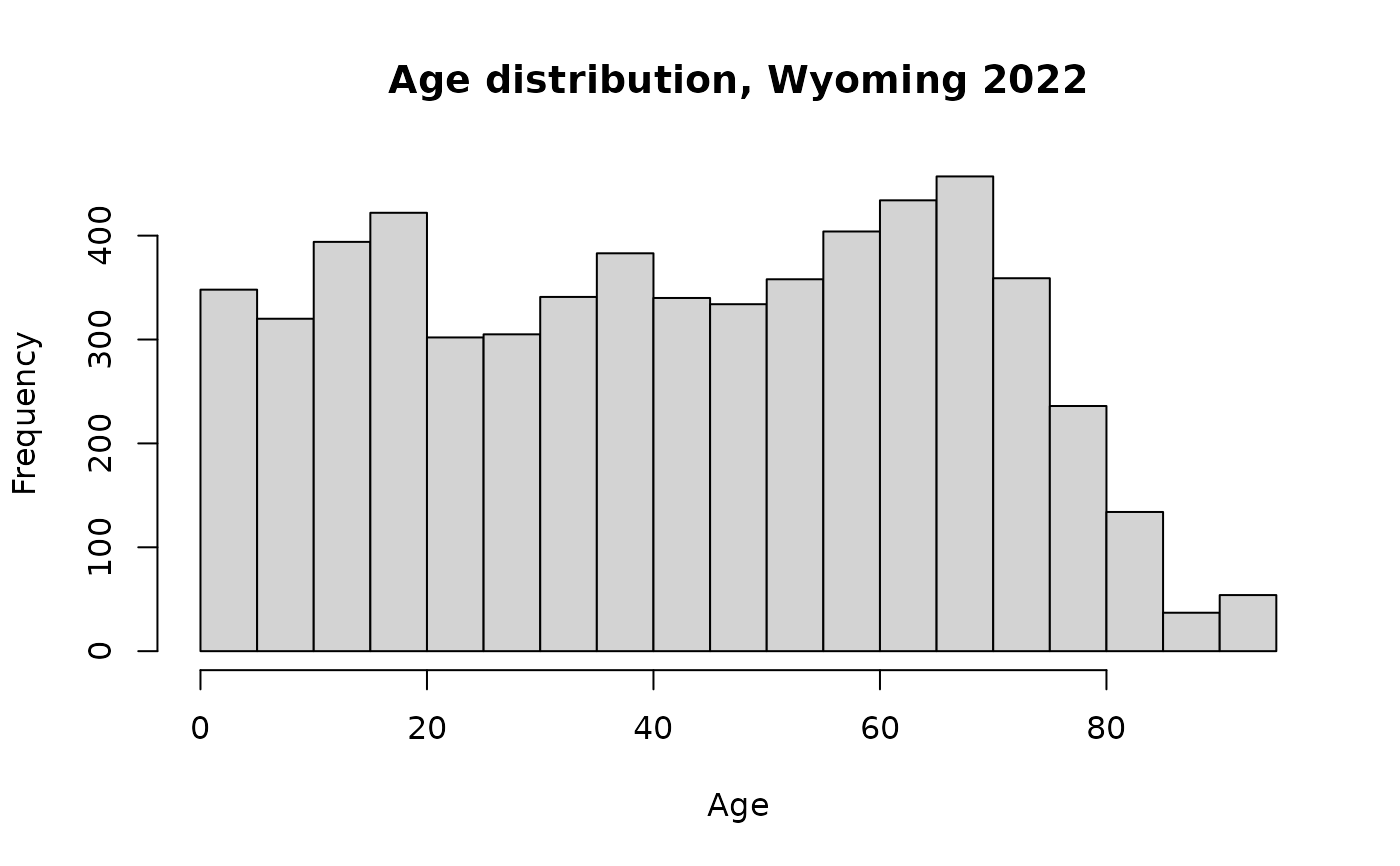
All person records from the 2022 American Community Survey (ACS) 1-Year Public Use Microdata Sample (PUMS) for Wyoming (state FIPS 56). Wyoming is the least-populous U.S. state, making this the smallest state-level PUMS file — ideal for fast tests and examples.
Format
A data frame with 5,962 rows and 96 variables.
Columns pwgtp1 through pwgtp80 are the 80 successive difference
replicate weights for variance estimation; the remaining 16 variables are:
puma: Public Use Microdata Area code. Use as the cluster ID (PSU) for variance estimation.st: State FIPS code (all 56 = Wyoming).pwgtp: Person weight. Represents the number of people in the Wyoming population that this record represents.agep: Age (0–99 years).sex: Sex (1 = male, 2 = female).rac1p: Recoded detailed race (1 = White alone, 2 = Black or African American alone, 3 = American Indian alone, 6 = Asian alone, 9 = Two or more races).hisp: Recoded Hispanic origin (01 = Not Spanish/Hispanic/Latino; 02–24 = specific Hispanic origin).schl: Educational attainment (24 categories: 01 = no schooling, 16 = regular high school diploma, 21 = bachelor's degree, 24 = doctorate degree).esr: Employment status recode (1 = civilian employed at work, 2 = civilian employed with job but not at work, 3 = unemployed, 4 = Armed Forces at work, 5 = Armed Forces not at work, 6 = Not in labor force).pincp: Total person income in the past 12 months (dollars, signed; negative values indicate a net loss). Multiply byadjinc / 1e6to adjust to constant dollars.wagp: Wages or salary income in the past 12 months (dollars).NAif not applicable.hicov: Health insurance coverage (1 = with health insurance, 2 = without health insurance).dis: Disability recode (1 = with a disability, 2 = without a disability).povpip: Income-to-poverty ratio (0–501; 501 means 501% or more).wkhp: Usual hours worked per week in the past 12 months.NAif not in the labor force.adjinc: Adjustment factor for income and earnings. Divide by 1,000,000 and multiply income variables to convert to 2022 constant dollars.
Source
U.S. Census Bureau. 2022 ACS 1-Year PUMS. https://www.census.gov/programs-surveys/acs/microdata/access.html
Details
Survey design: Successive difference replication (SDR). Use
as_survey_replicate() with all 80 replicate weights:
svy <- as_survey_replicate(
  acs_pums_wy,
  weights    = pwgtp,
  repweights = pwgtp1:pwgtp80,
  type       = "successive-difference"
)
Income adjustment: Income variables (pincp, wagp) are in survey-year
dollars. Multiply by adjinc / 1e6 to convert to 2022 inflation-adjusted
dollars before comparing across ACS years.
Metadata:
The ACS PUMS source is a plain CSV with no embedded labels. Columns in
acs_pums_wy carry no "label", "labels", or "question_preface"
attributes. Variable descriptions are documented here in ?acs_pums_wy and
in data-raw/README.md. Use set_var_label() and
set_val_labels() to attach labels manually before analysis if needed.